Detangling Matted Natural Hair Without Losing Length
Matted hair can almost always be saved. It takes slip, sections and hours — never force.
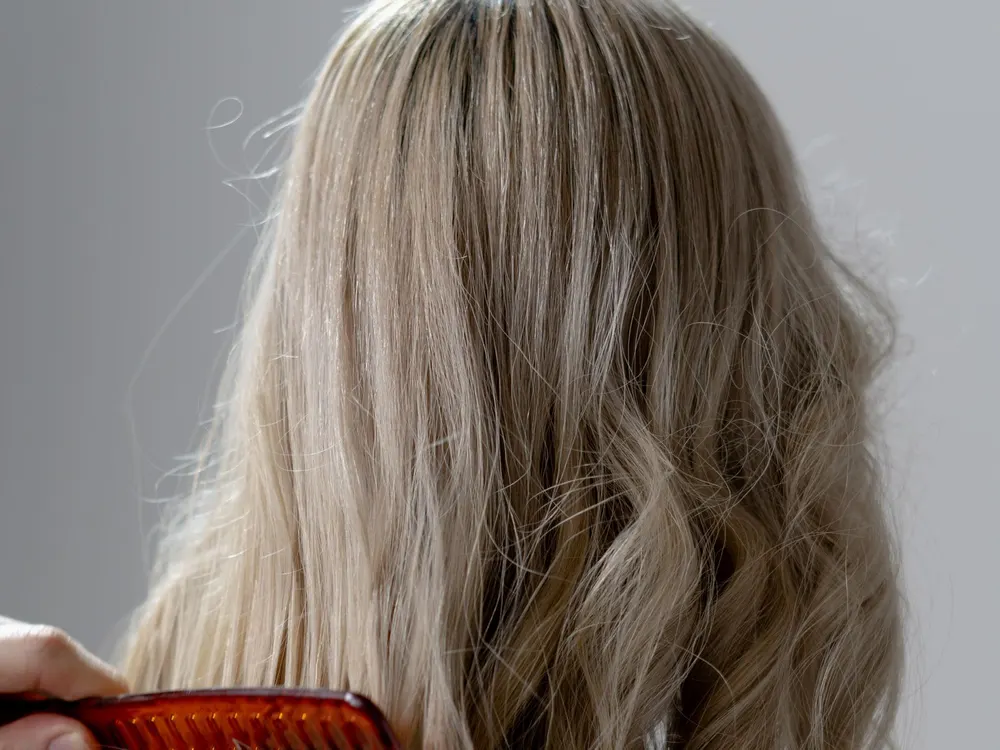
Matting happens after a long protective style, after weeks of neglect, after an illness, or after one wash day done in the wrong order. It looks unsalvageable. It usually is not.
What it takes is slip, small sections and time — often several hours across two days. What it does not take, ever, is force.
Before you start
Set aside a real block of time and accept that rushing costs hair. Have ready: a large amount of cheap slippery conditioner, a spray bottle of water, a wide-tooth comb, clips, and a bowl of warm water.
Do not shampoo first. Shampoo on matted hair tightens the tangle and makes everything worse.
The method
- Saturate. Spray the hair until it is genuinely wet, then coat it in conditioner — far more than feels reasonable. The whole job is buying slip.
- Section as far as you can. Even rough sections held with clips reduce the problem from one impossible mat to several manageable ones.
- Start at the ends. Always. Work on the last inch until it is free, then the next inch. Combing from the root drags every tangle in the section into one knot at the bottom.
- Fingers before tools. Separate with your fingers and pull the mat apart gently, strand by strand where needed. A comb is for the final pass, never the first.
- Add more conditioner and more water the moment something resists. Resistance means not enough slip, not enough force.
- Twist each finished section and clip it away so it cannot re-tangle while you work on the next.
For severe matting
Add oil — coconut or olive — on top of the conditioner. Apply gentle heat under a cap for twenty minutes; warmth softens the strand.
Work in very small sections, an inch at a time. If a knot will not release after several minutes of patient work with plenty of slip, leave it, move on, and come back to it. Fatigue is what turns careful work into pulling.
Split the job across two sessions. Two calm hours today and two tomorrow will save more hair than four exhausted hours tonight.
When to cut
Sometimes a single knot has locked, or an inch of ends has fused. Cutting that inch is not failure — it is the cheaper option. A knot that stays becomes the centre of the next mat, and you lose more length to it over the following months than the scissors would have taken today.
Cut the knot, not the section. And cut with sharp shears, not kitchen scissors, which crush the strand and cause more splits.
Afterwards
Once detangled: clarify to remove the products you have just piled on, then deep condition properly. Your hair has been through mechanical stress and needs both protein and moisture over the following weeks.
Then put it into a low-manipulation style — twists or braids — and leave it alone for a while.
Preventing the next one
- Detangle before and after every protective style, never only after.
- Take styles down at 6 to 8 weeks, whatever they still look like. Beyond that you are detangling weeks of shed hair at once.
- Section for every wash day. This is the single biggest preventive habit.
- Satin at night, always.
- Keep hair moisturised — dry hair tangles far more readily than hydrated hair.
Shed hair is the real culprit. You lose 50 to 100 strands a day; in a protective style they stay woven in, and by week ten there are thousands of them looking for something to wrap around.
Detangling brushes and combs → · Detangling brushes and combs →


